
Follow one message from your phone to someone else’s
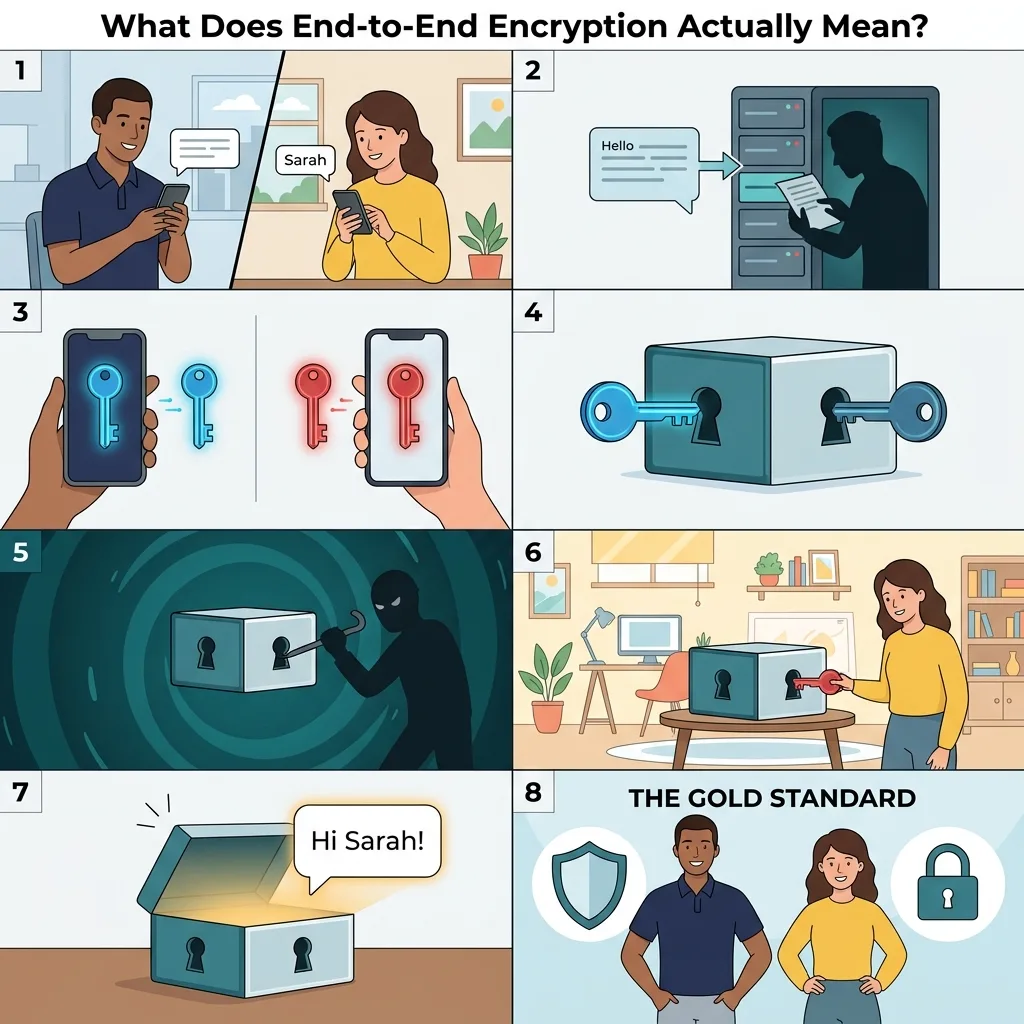
You type a message and press Send.
At that moment, the text exists in a readable form on your device because the messaging app needs to display what you wrote.
In an end-to-end encrypted system, the message is then transformed into encrypted data before it travels through the service’s infrastructure. The servers responsible for routing the message receive something they can deliver but, when the system is designed as promised, cannot turn back into the readable conversation themselves.
The recipient’s device performs that last step.
It receives the encrypted message, uses the cryptographic information available to that endpoint, and reconstructs the text so the recipient can read it.
That basic path explains the name:
one end → encrypted journey → other end
The “ends” are the devices or clients participating in the protected communication.
Signal describes its conversations as end-to-end encrypted so that messages and calls can be read or heard only by the intended recipients. Its official privacy explanation makes the encryption part of the normal communication model rather than an optional private mode.
Apple describes iMessage similarly. Its iMessage security overview explains that message content and attachments are protected with end-to-end encryption and that Apple cannot decrypt that protected content.
The important idea is not that the message somehow avoids servers.
It usually does not.
The service can still help find the recipient’s devices, route encrypted data, queue delivery, and perform other communication tasks.
End-to-end encryption changes what the intermediary can read, not whether an intermediary exists.
Encryption during transport is not automatically end-to-end encryption
Many internet connections are encrypted without being end-to-end encrypted in this sense.
When you visit an HTTPS website, your browser normally creates an encrypted connection to the website’s server. Someone casually observing the network should not be able to read the traffic as plain text while it moves between you and that server.
The server itself, however, generally needs access to the information you send.
If you sign into an online store, the store has to process your account information.
If you submit a search query, the search service needs the query in order to provide results.
This is often described as encryption in transit.
The connection between two points is protected while data travels, but one of those points may be the service provider itself.
End-to-end encryption moves the readable endpoints farther outward.
In a private messaging example, the desired endpoints are your device and the recipient’s device rather than your device and the messaging company’s server.
That distinction changes the service provider’s technical position.
A conventional server-side messaging architecture may receive readable message content, store it, process it, and later deliver it.
An end-to-end encrypted architecture is designed so that the server handles encrypted material while the keys needed to recover the conversation remain with the communicating endpoints.
This is why the phrase matters.
Saying merely that an app “uses encryption” does not tell you enough. Almost every reputable modern online service uses encryption somewhere.
The useful question is:
Encrypted between which two points?
The provider may still handle information around the message
Protecting the content of a conversation does not necessarily make every piece of information associated with that conversation disappear.
A messaging system still has operational problems to solve.
It may need to know where to deliver data.
It may process account identifiers.
It may record timestamps.
It may need information about devices connected to an account.
The general term metadata is often used for information about communication rather than the communication content itself.
Examples can include things such as:
- when an event occurred;
- which account or device participated;
- routing information;
- delivery information;
- device or service identifiers.
Exactly what metadata exists — and how well it is protected — depends on the service.
This distinction should not be turned into the opposite exaggeration either. “Metadata exists” does not mean every encrypted messenger collects the same metadata.
Signal, for example, deliberately designs its service to retain very little information and applies protections beyond message content. Its documentation says the service cannot access the messages, calls, contacts, groups, and many other categories associated with normal communication.
Apple’s technical description of iMessage illustrates the distinction from another direction. Apple documents message content as end-to-end encrypted while noting that certain routing information used by its push-notification infrastructure is not protected in exactly the same way as message content.
So the accurate conclusion is narrower:
End-to-end encryption primarily tells you something important about access to the protected content. It does not, by itself, describe every piece of data the service may process.
That is one reason privacy evaluation cannot stop at seeing a lock icon.
The endpoints are powerful because they can read the message
The same design that prevents an intermediary from reading a message requires your device to be able to read it.
That sounds obvious until you consider the consequences.
Once the message appears on your screen, encryption between devices has already completed its main job.
Your device can expose what encryption protected in transit
Someone who unlocks your phone may be able to read your conversations.
Malicious software operating with sufficient access could potentially capture information after it has been decrypted.
Notification previews can reveal message content on a Lock Screen.
Screenshots can create separate copies.
A linked computer or tablet may become another place where conversations are readable.
End-to-end encryption does not turn an insecure endpoint into a secure one.
This is why device security remains relevant even when the messaging protocol is strong. A screen lock, operating-system updates, sensible app permissions, and careful account protection address risks that exist outside the encrypted transport itself.
How to Check and Change App Privacy Permissions covers one part of that endpoint security.
The recipient is also an endpoint
Encryption cannot stop the intended recipient from doing something with information after receiving it.
The person can take a screenshot.
They can photograph the screen with another device.
They can copy text into a different app.
They can forward information.
They can show the conversation to someone standing nearby.
This is not a cryptographic failure.
The system successfully delivered the readable message to an endpoint you authorized to receive it.
Privacy technology can control parts of the delivery path. It cannot guarantee what another human being does once the information legitimately reaches them.
That distinction is particularly important when conversations contain sensitive photos, documents, passwords, personal information, or confidential work material.
Backups can create another copy outside the live conversation
A messaging conversation may be protected strongly while it travels between devices and still produce another question:
What happens when the conversation is backed up?
A backup is a separate copy.
Its protection depends on the backup system.
Some messaging services provide end-to-end encrypted backups. Signal’s optional Secure Backups, for example, are protected with end-to-end encryption and a recovery key that Signal says it does not possess.
Other systems can have different backup models or offer stronger protection only under particular settings.
Apple provides a useful example of why this requires precision. iMessage itself uses end-to-end encryption, while the protection of Messages data stored through iCloud can depend on the iCloud security configuration. Apple’s iCloud data security overview explains the difference between standard protection and Advanced Data Protection for categories including backups and Messages in iCloud.
This does not mean one should conclude that “cloud backups are unsafe.”
It means message encryption and backup encryption are separate questions.
Ask whether a backup exists.
Then ask how that backup is encrypted.
Then ask who holds the keys needed to recover it.
Those questions also apply outside messaging. How to Back Up Important Photos and Documents explains why creating another copy improves resilience but also creates another location that needs appropriate protection.
Security often involves balancing those two goals: keeping information private and making sure you do not lose it permanently.
A group conversation has more endpoints than a private conversation
A conversation between two people has an intuitive pair of endpoints.
Group chats are more complicated because several people — and often several devices per person — need access to the conversation.
An end-to-end encrypted group service therefore has to make protected content available to every legitimate participant while preventing the service itself or outsiders from simply reading the conversation.
From the user’s perspective, the practical consequence is more important than the cryptographic machinery.
Adding someone to a group adds another authorized recipient.
Every legitimate participant becomes another place where the conversation can be read.
If ten people belong to an encrypted group, end-to-end encryption may still provide strong protection against interception or server-side access, but ten people can now see what is written.
The privacy boundary changed because the audience changed.
Linked devices matter for a similar reason.
A person may use the same messaging account on a phone, tablet, and desktop computer. Secure messaging systems need ways to authorize those devices and deliver protected messages appropriately.
That convenience expands the set of endpoints you should recognize.
If an app offers a list of linked devices, checking it occasionally can be worthwhile. An unfamiliar authorized device deserves investigation because encryption does not help if an unauthorized person successfully becomes one of your trusted endpoints.
End-to-end encryption does not automatically prove who is on the other end
Suppose the system successfully encrypts a conversation from your device to another device.
That still leaves an identity question:
Does that device actually belong to the person you think it does?
Messaging systems address this in different ways.
Signal provides safety numbers that can be compared to help verify that a conversation is encrypted with the intended person rather than an unexpected intermediary.
Apple offers iMessage Contact Key Verification for users who need additional assurance that they are communicating with the intended people. Apple’s Contact Key Verification documentation describes alerts and verification mechanisms designed for more sophisticated threat situations.
Most everyday users will not manually verify cryptographic identities before every conversation.
They should still understand the distinction.
Encryption protects the path between established endpoints.
Identity verification helps establish confidence about whose endpoint that actually is.
This becomes particularly relevant when a contact unexpectedly asks for money, credentials, verification codes, or sensitive information. A perfectly encrypted message from a compromised account can still carry a fraudulent request.
How to Protect Your Personal Information Online addresses the broader problem of deciding what information should be shared even when the communication channel itself appears legitimate.
A secure channel does not make every message inside it trustworthy
End-to-end encryption protects messages from certain forms of access.
It does not judge whether the content is true.
A scammer can use an encrypted messenger.
A malicious file can be sent through an encrypted conversation.
A person can lie in an encrypted message.
A compromised account can send convincing requests through a channel whose cryptography is functioning exactly as designed.
This distinction matters because security indicators can create too much confidence.
A lock icon answers a technical question about the communication.
It does not certify the intentions of the person communicating with you.
The same is true of disappearing messages. Automatically deleting a message after a period can reduce how long copies remain inside an application, but it cannot prevent a recipient from preserving the information another way.
No single feature carries the entire burden of privacy.
Encryption protects a layer.
Device security protects another.
Account authentication protects another.
Human judgment remains involved in deciding what you send, who receives it, and whether an unexpected request makes sense.
Read “end-to-end encrypted” as a specific promise
The phrase becomes more useful when you resist expanding it beyond what it actually says.
It does not mean invisible.
It does not mean anonymous.
It does not mean every associated piece of metadata is necessarily hidden.
It does not mean the devices at either end cannot be compromised.
It does not mean backups automatically receive identical protection.
It does not mean the person receiving the message will keep it private.
What it does describe is still significant.
The protected content is designed so that it can be turned back into readable information at the authorized endpoints rather than at every intermediary carrying it between them.
The next time an app advertises end-to-end encryption, there is therefore no need to translate the phrase into either “completely private” or “meaningless marketing.”
Read it more literally.
Ask where the endpoints are, what content receives that protection, what happens to backups, and what other information the service retains.
Those questions make the label smaller than a blanket promise — and much more useful.

Alex Carter is a technology writer with five years of experience in the tech field. He now focuses on creating clear, practical articles that help beginners in the United States better understand computers, smartphones, online services, and everyday digital technology.