
Typing a few words into a search box feels almost instantaneous. You ask about a restaurant, an unfamiliar computer error, a historical event, or the name of a song, and within moments a page appears containing links, images, maps, videos, answers, and other information that seems related to what you meant.
What happens during those moments is very different from searching the entire live internet from scratch. Search engines have already spent enormous amounts of time discovering pages, examining what they contain, organizing information about them, and building systems that can retrieve useful candidates when someone enters a query.
That distinction explains much of what otherwise seems mysterious about web search. A newly published page may not appear immediately. Two people can receive somewhat different results for the same words. A page does not need to repeat your exact phrase to be relevant, and the first result is not simply the website that used a keyword the greatest number of times.
Long before you search, automated crawlers are exploring the web
There is no master directory containing every webpage on the internet. Search engines have to discover pages continuously as sites are created, updated, connected, moved, and removed.
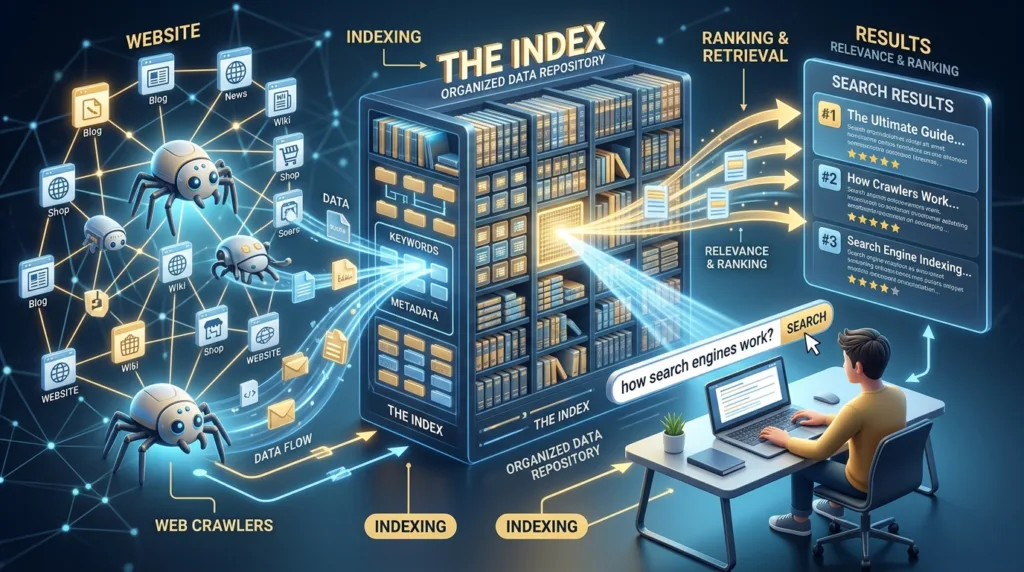
They do much of that work with automated programs commonly called crawlers, bots, or spiders.
A crawler can visit a page the search engine already knows, examine the links on it, and discover other URLs through those links. It may later visit those newly discovered pages and find still more connections. Website owners can also provide information such as sitemaps that help search engines discover URLs, but much of the web is found through this ongoing process of following connections.
Google calls its primary crawler Googlebot. In its official explanation of how Google Search works, Google describes crawling as the stage in which automated software downloads text, images, videos, and other page resources from URLs it has discovered. Bing uses its own crawler, Bingbot, and similarly relies on crawling and links to discover material across the web.
A crawler does not simply wander without limits. Websites can provide technical instructions about what automated systems may access, pages can require a login, servers can be temporarily unavailable, and search engines make their own decisions about what to revisit and how frequently.
This is why being publicly available on the web does not automatically mean a page has already been seen by every search engine.
Picture one new page entering the system
Suppose a local bakery publishes a page describing its new weekend menu.
At first, the search engine may know nothing about that specific URL. Perhaps the bakery’s homepage links to it. A crawler later revisits the homepage, notices the new link, and discovers the menu page.
The crawler can then request the page and examine what is there.
At this point, however, discovery alone does not mean the menu will immediately appear when someone searches for weekend bakery menu near me. Another important process still has to happen.
The search engine builds an index rather than memorizing a list of links
After discovering and crawling a page, a search engine tries to understand enough about it to make the page useful later.
This stage is generally called indexing.
The word makes more sense if you think about the index at the back of a large textbook. You do not reread every page of the book whenever you want to find where a subject appears. The index gives you an organized way to locate relevant material.
A web search index is vastly more complex, but the broad idea is similar.
Search systems can process page text, headings, images, videos, links, language, and other information. They may identify that our fictional bakery page discusses sourdough bread, Saturday opening hours, a particular neighborhood, and seasonal pastries. Information about that page can then become part of the search engine’s index.
Google describes its index as a very large database containing information gathered during this processing stage. It also notes that crawling does not guarantee indexing: a search engine can discover a page without necessarily deciding to store it in the index or show it in search results.
Bing makes the same distinction. Its documentation about pages missing from the Bing index lists several reasons a discovered site might not be indexed, including crawling problems, technical restrictions, and content-quality considerations.
This separation between the web itself and a search engine’s index of the web is one of the most useful ideas for understanding search.
Then you type a query, and a different problem begins
Imagine that you search for:
bakery open sunday near me
The search engine now has to interpret what you are asking and find useful candidates from its existing index.
There is more meaning in those four words than their literal spelling suggests. Bakery identifies the type of place. Open Sunday implies current operating information. Near me makes location unusually important.
Compare that with:
why does sourdough bread rise
Location suddenly matters much less. The search has become informational rather than local.
Or consider:
bakery website
That could indicate an attempt to reach a specific site rather than learn how baking works or discover nearby businesses.
Search engines therefore try to understand the intent and context of a query rather than performing only a mechanical hunt for pages containing an identical string of words.
Google’s consumer explanation of Search says its ranking systems consider factors that can include the query itself, relevance and usability of pages, the nature of sources, location, and settings. The relative importance of those signals changes according to the search.
That final point matters. There is no single recipe applied with exactly the same priorities to every query.
Freshness may matter greatly for breaking news. Distance becomes important for a nearby coffee shop. For a definition of a stable scientific term, being published five minutes ago may provide little advantage.
Ranking is the process of choosing among many possible answers
Finding pages related to a query is not enough.
A search for a broad subject could have thousands, millions, or more potentially related pages. Showing all of them without useful ordering would leave most of the work to the person searching.
Search engines therefore use ranking systems to decide which results appear more prominently.
A very simplified version of the process looks like this:
- Interpret the query. What is the person probably looking for?
- Retrieve candidates from the index. Which stored pages appear relevant?
- Evaluate and order those candidates. Which results seem most useful for this particular search?
- Build the results page. Present the appropriate mix of webpages and other search features.
The real systems are considerably more complicated, and search companies do not publish a complete formula that would allow anyone to calculate exactly where a page will appear.
What is important for a beginner is that ranking is comparative.
A webpage is not assigned a universal score that guarantees it will always appear third in search results. Its relevance depends on the query and on other available information.
A detailed beginner guide to replacing a laptop battery might be highly relevant for:
how to replace laptop battery
The same page would have little reason to appear prominently for:
best laptop for college student
Both queries contain laptop, yet the underlying needs are different.
This is also why repeating a phrase dozens of times does not automatically make a page the best result. Modern search systems look well beyond simple word counts when trying to connect queries with useful information.
Search results are no longer just ten blue links
A search-results page can change dramatically according to what you ask.
Search for a business and you may encounter a map, opening hours, photos, reviews, and directions. A calculation may produce an answer directly. A question about an unfamiliar object can surface images. Current events may bring news coverage, while a search for a video topic can emphasize video results.
Traditional webpage links remain important, but they share the page with an expanding set of search features.
You may also see sponsored results. Advertising and ordinary search ranking are separate systems. Google states in its Search documentation that payment does not buy a higher position in its organic web-search rankings. Ads are identified separately even when their visual placement is near other results.
The appearance of the results page can therefore tell you something about how the search engine interpreted the query.
Searching weather chicago does not require the same presentation as history of chicago architecture. The first benefits from immediate current information; the second is better served by material that can be explored in depth.
Search has gradually become an interface for different kinds of information rather than a single list format.
Why two searches that look identical can produce different results
Search results are not necessarily frozen.
Location is an obvious example. Two people searching pizza from different cities would find little value in receiving exactly the same local restaurants.
Language can change which sources are useful. The type of device may influence certain results or how they are displayed. Information available to the search engine can also change as new pages are discovered and existing ones are updated.
Even the wording of a search can alter the result set more than a beginner might expect.
Compare:
jaguar speed
jaguar car speed
jaguar animal running speed
The additional words remove ambiguity.
Search engines can often infer related concepts without requiring perfectly chosen terminology, which is why you do not always need to know the exact technical vocabulary before searching. Google’s search guidance for users notes that relevant results can contain related terms even when they do not reproduce every word from the query.
Still, clearer searches give the system better clues.
Adding a model number to a technical problem, a city to a local search, a year to a historical event, or the name of the software involved can narrow an overly broad question without requiring special search syntax.
This is one reason searching effectively is partly a conversation between what you type and what the results reveal. An initial search can teach you vocabulary that helps you phrase the next search more precisely.
Search engines make choices, so results still deserve judgment
A high ranking can make a result easier to discover. It does not eliminate the need to think about the information after opening it.
Search systems are trying to estimate usefulness and relevance at enormous scale. They do not transform every result into an unquestionable source.
The level of scrutiny you need depends on what you are searching for. Instructions for changing a desktop wallpaper have very different consequences from medical advice, a financial decision, legal information, or an urgent security warning.
Look at who published the material, whether the information actually answers your question, whether the topic requires current information, and whether important claims can be confirmed elsewhere when the consequences matter.
Search results can also contain pages that are relevant to your words without being appropriate for your purpose. A five-year-old tutorial might explain the correct general concept but show an interface that no longer exists. A forum discussion can reveal a useful experience while remaining less authoritative than the official documentation for a technical feature.
Our guide How to Tell If a Website Is Safe to Visit covers another part of this evaluation: deciding whether the website you reached is actually the site it claims to be.
Search is extremely good at finding possibilities. Evaluating those possibilities remains partly your job.
Common questions about how search engines work
Does Google search every website on the internet when I press Enter?
No. Search engines primarily retrieve information from indexes they have already built. Crawling and indexing take place continuously before individual searches. The query then triggers retrieval and ranking from that stored information.
Why doesn’t a brand-new webpage appear immediately?
The search engine may not have discovered it yet, may not have crawled it, or may not have indexed it after processing the page. Even an indexed page is not guaranteed to appear prominently for a particular query.
Do websites pay Google to rank first in normal search results?
Google states that it does not accept payment to rank pages higher in its organic search results. Advertising can appear on a search-results page, but ads are separate from ordinary organic ranking.
Is the first result always the most trustworthy source?
Not necessarily. A high position indicates that the ranking system considered the result useful or relevant for the query according to its signals. The appropriate level of source checking still depends on the subject and what you plan to do with the information.
The search box is only the visible end of a much larger system
By the time you type a question, much of the work has already happened.
Crawlers have been moving through the web discovering URLs. Search systems have processed some of those pages and built indexes containing information about them. When your query arrives, ranking systems interpret what you appear to need, retrieve candidates, compare them, and assemble a results page suited to that particular search.
Understanding that sequence changes the way search feels.
You no longer have to imagine Google or Bing opening billions of live websites one by one while you wait. You can understand why a new page may take time to appear, why location changes local results, why two similar searches produce different pages, and why a search engine can connect your question with content that does not repeat the exact words you typed.
Most of the machinery remains invisible, as it should. What reaches you is a search box and a page of possibilities. Knowing a little about what happened before those possibilities appeared makes it easier to search more deliberately — and to judge the results with more confidence once you find them.

Alex Carter is a technology writer with five years of experience in the tech field. He now focuses on creating clear, practical articles that help beginners in the United States better understand computers, smartphones, online services, and everyday digital technology.